Incentivizing Social Good With Financial Rewards
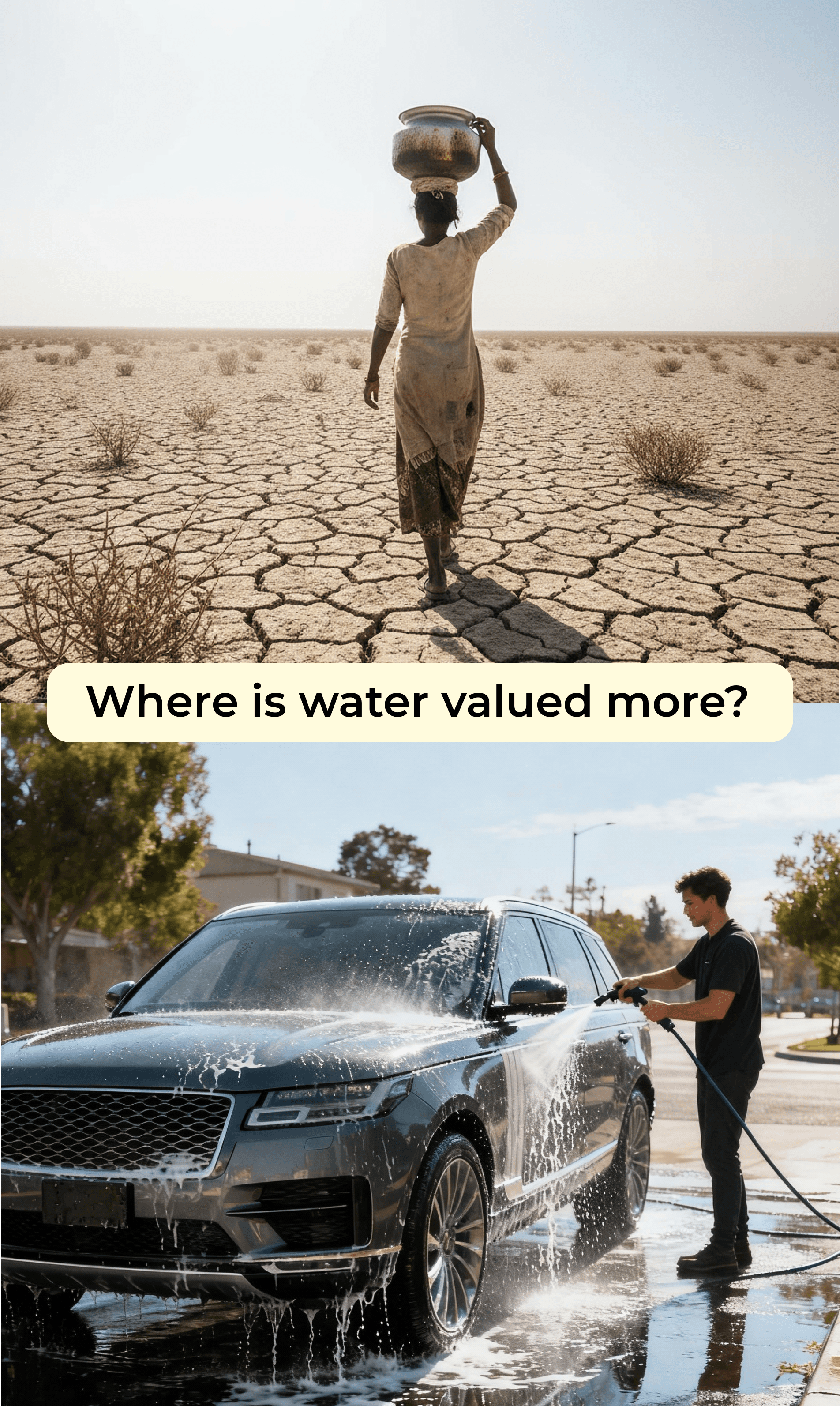
Image showing contrast between value of water in two different scenarios.
People often undervalue what comes easily—whether it's water in a tap or digital coins mined with a home computer. But scarcity is a powerful driver of value. On this page, discover how scarcity principles from both environmental and digital mining shape the future of social impact—and how SIR tokens transform every dollar donated into real social benefits.
People often undervalue what comes easily—whether it's water in a tap or digital coins mined with a home computer. But scarcity is a powerful driver of value. On this page, discover how scarcity principles from both environmental and digital mining shape the future of social impact—and how SIR tokens transform every dollar donated into real social benefits.
Consider water. In many parts of the world, communities walk miles just to collect small amounts of clean water, treasuring every drop because of its scarcity. Meanwhile, in places where water is cheap and readily available, it is often taken for granted and wasted carelessly. According to research by Boston Consulting Group, water is severely undervalued globally, with prices paid by consumers frequently bearing little relation to water's true economic, social, and environmental value.
This undervaluation has led to chronic underinvestment in water infrastructure and conservation efforts, exacerbating scarcity issues that now threaten global stability.
Bitcoin's Growing Energy Use
Bitcoin's Growing Energy Use
Bitcoin offers a striking modern parallel to this scarcity-value relationship. In May 2010, when 10,000 bitcoins were famously used to buy two pizzas, the entire Bitcoin network operated at just 43.5 megahashes per second (MH/s). At that time, generating 1 terahash per second (TH/s) of computing power required approximately 2.3 million watts of electricity, consuming about 55,172 kilowatt-hours per day.
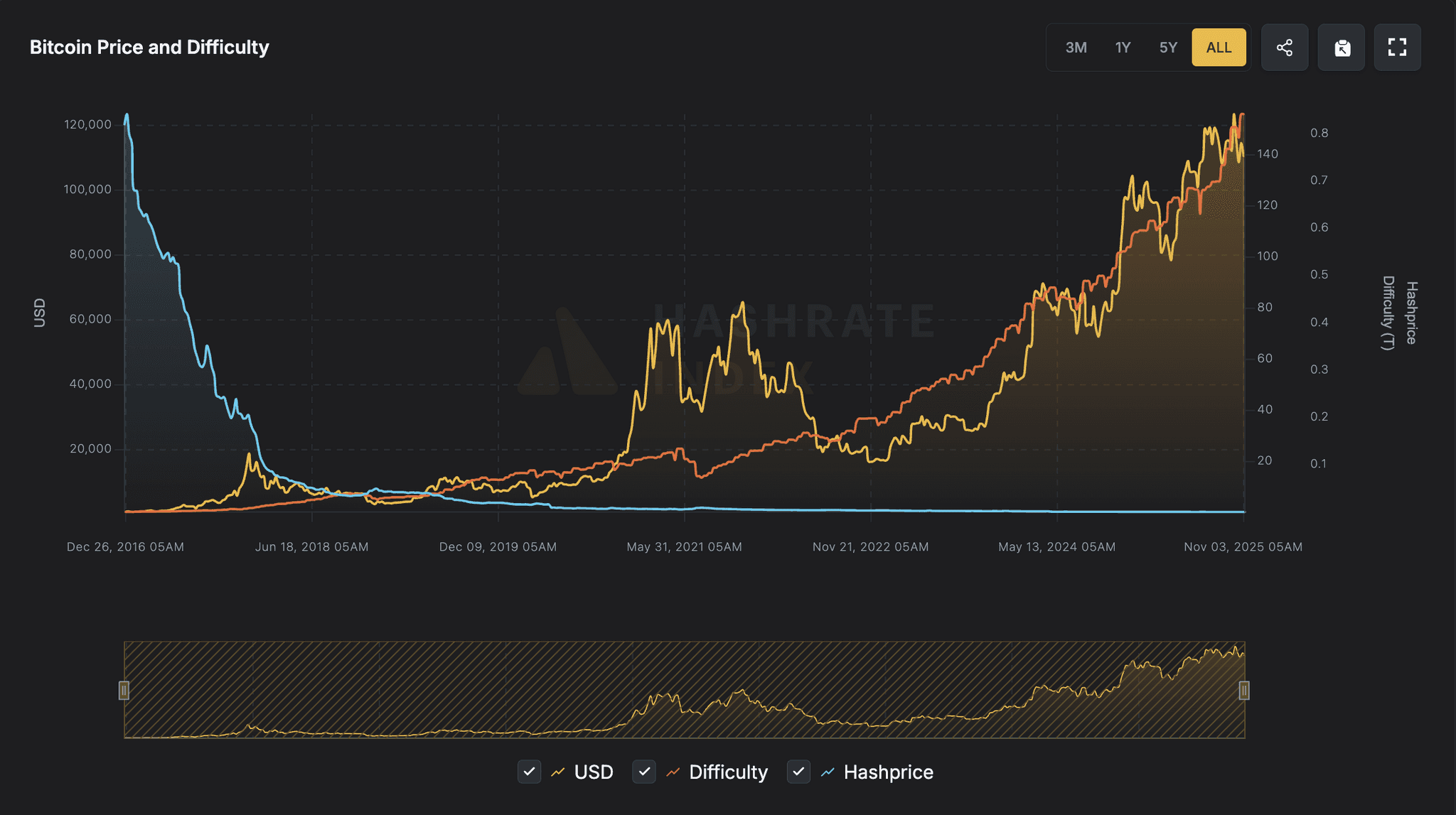
A graph showing Bitcoin's difficulty and price in USD
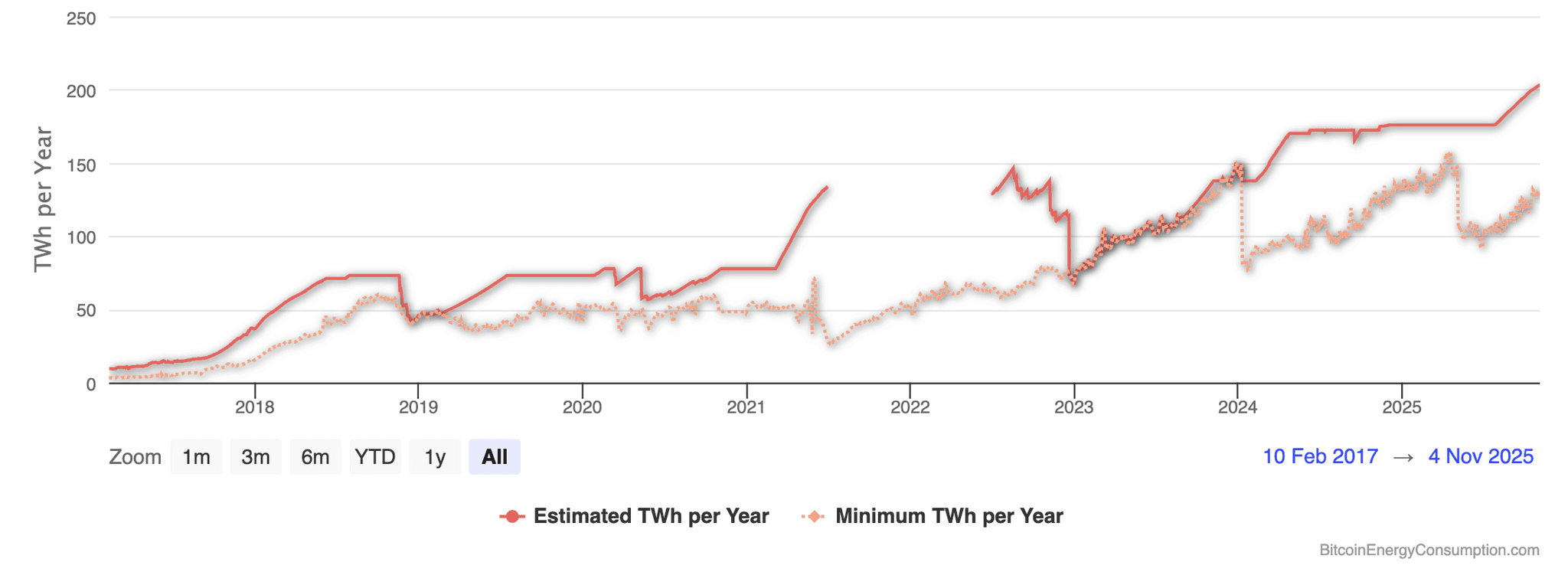
Fast forward to November 2025, and the landscape has transformed dramatically. The Bitcoin network now operates at approximately 1,082 exahashes per second (EH/s)—representing a staggering 24.9 trillion times increase in computing power. Today's mining hardware has become roughly 50,000 times more energy-efficient per unit of computing power, requiring only 46 watts to generate 1 TH/s, or about 1.1 kilowatt-hours per day. However, despite this remarkable efficiency improvement, the massive scale increase means the total network now consumes approximately 11.4 million times more energy than in 2010.
A graph showing Bitcoin's energy consumption over time
This exponential growth in mining difficulty helps reinforce Bitcoin's scarcity—one of the drivers of it's high market value, with Bitcoin exceeding $100,000 per coin in recent years. The scarcity principle in economics explains how limited supply relative to demand increases perceived value and price.
Social Impact Rewards: Scarcity Meets Purpose
Social Impact Rewards: Scarcity Meets Purpose
Social Impact Rewards (SIR) is applying a similar limited supply model, but swapping out electricity consumption for social good. As of November 1, 2025, donors using the SIR Giving platform earn 1 SIR token for every $5 to $10 donated via our verified 501(c)(3) partner, Every Org. Like Bitcoin's mining difficulty, future donations will have to be larger to earn the same number of tokens, creating a form of social scarcity that rewards early and impactful giving.
This design incentivizes sustained, meaningful contributions while increasing the perceived value of SIR tokens over time—but instead of consuming exponentially more electricity, SIR channels that competitive energy into measurable social impact.
The Economics of Scarcity
The Economics of Scarcity
What these examples highlight is a fundamental economic truth: scarcity matters. Resources or rewards that are abundant tend to be undervalued, often wastefully so. Conversely, scarcity drives conservation, investment, and higher perceived worth. Understanding this principle can inspire better resource management—whether for critical essentials like water, digital assets like Bitcoin, or innovative social impact currencies like SIR tokens.
As we advance into a future where both traditional and emerging assets compete for attention, recognizing and harnessing scarcity mechanisms can help us build value systems that are not only economically sound but socially beneficial. The question isn't whether scarcity creates value—it's what kind of behavior we choose to incentivize with that scarcity.
Where Generous
People Give
SIR Giving © 2026 All rights reserved
Where Generous
People Give
SIR Giving © 2026 All rights reserved
Where Generous
People Give
SIR Giving © 2026 All rights reserved